

 ENG
ENG  русский
 Español
 عربى
عربىWhy bother with a patch panel?
2026-02-23
Content
The Bottom Line: Why a Patch Panel is Essential
You bother with a network patch panel because it acts as the critical bridge between the rigid, permanent wiring inside your walls and the active electronics in your server rack. Without it, you risk physical damage to your cables, suffer from "spaghetti" wiring messes that make troubleshooting impossible, and lose the ability to easily reconfigure your network. It transforms a chaotic bundle of wires into a professional, labeled, and scalable system that protects your hardware investment.
Protecting Infrastructure from Physical Fatigue
In-wall Ethernet cables, particularly high-performance Cat6a lines, are typically made of solid copper conductors. While excellent for carrying signals over long distances, solid copper is brittle. If you plug these cables directly into a network switch, every time you move the switch or bump a cable, the copper inside can develop micro-fractures.
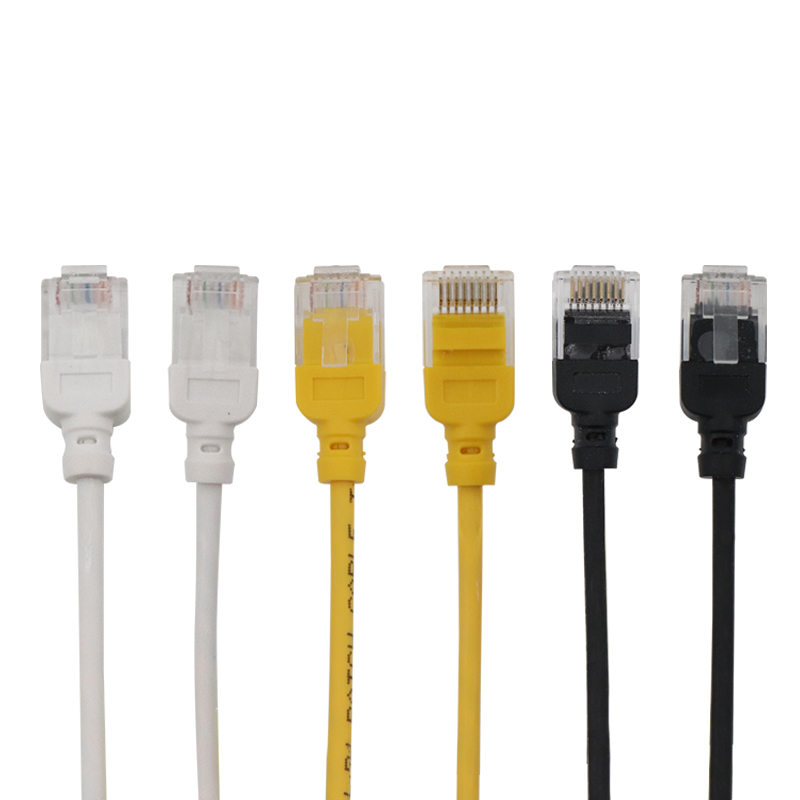
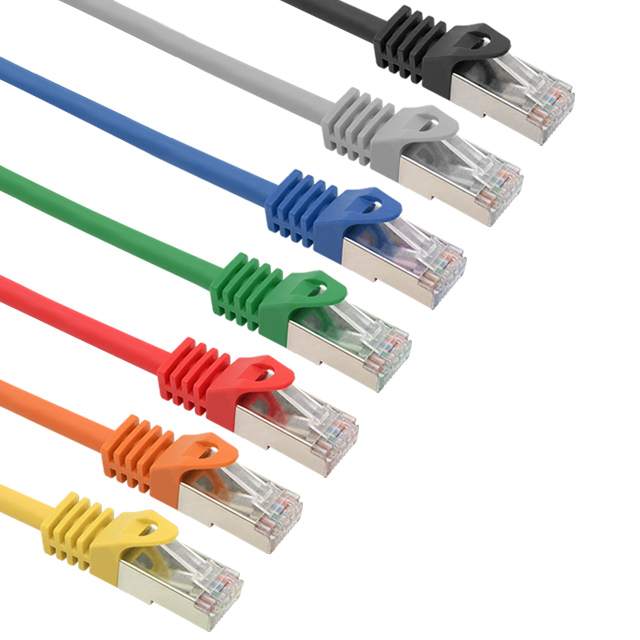
A network patch panel solves this by providing a "static termination point." The in-wall cables are punched down into the back of the panel and never move again. You then use flexible, stranded "patch cords" to connect the panel to your switch. If a patch cord breaks, it costs a few dollars to replace; if the cable inside your wall breaks, you face an expensive and labor-intensive re-pulling project.
Simplifying Maintenance and Troubleshooting
When a single room loses internet connectivity, finding the right wire in a bundle of 24 or 48 identical blue cables is a nightmare. A patch panel brings order to this chaos through standardized labeling and logical grouping.
Efficiency Gains in Network Management
- Clear Labeling: Most panels include built-in labeling strips where you can mark "Kitchen," "Office A," or "CCTV North."
- Quick Path Isolation: Technicians can use a tone generator at the wall jack and instantly locate the corresponding port on the panel without unplugging the entire network.
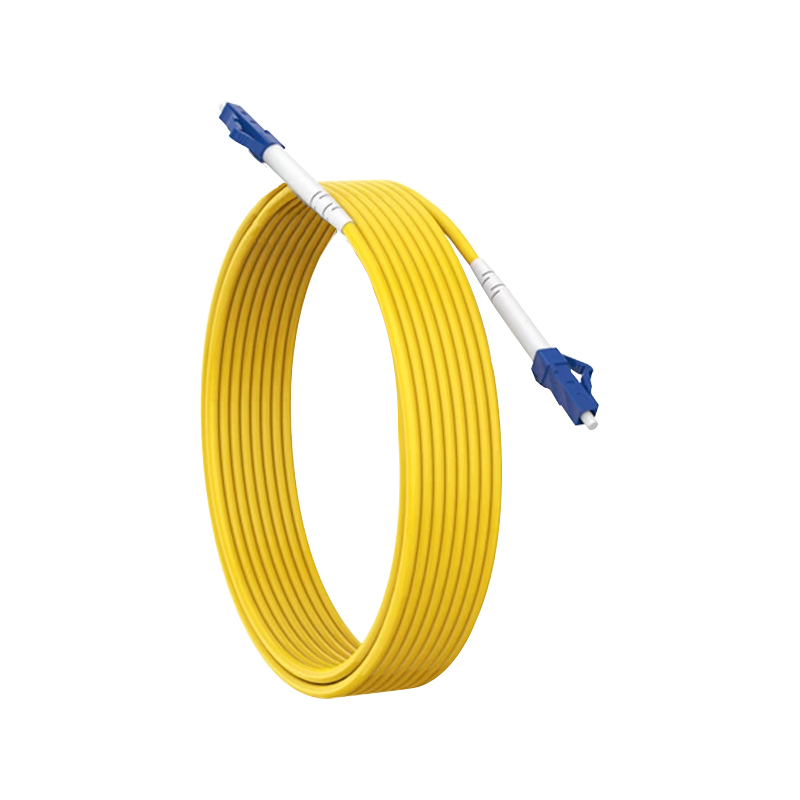
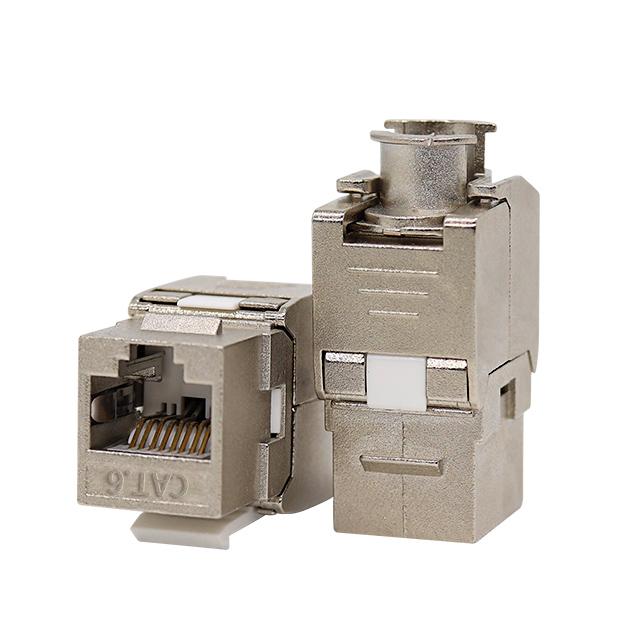
- Modular Flexibility: By using a panel with keystone jacks, you can mix and match different types of connections (Cat6, Fiber, Coax) in a single rack unit.
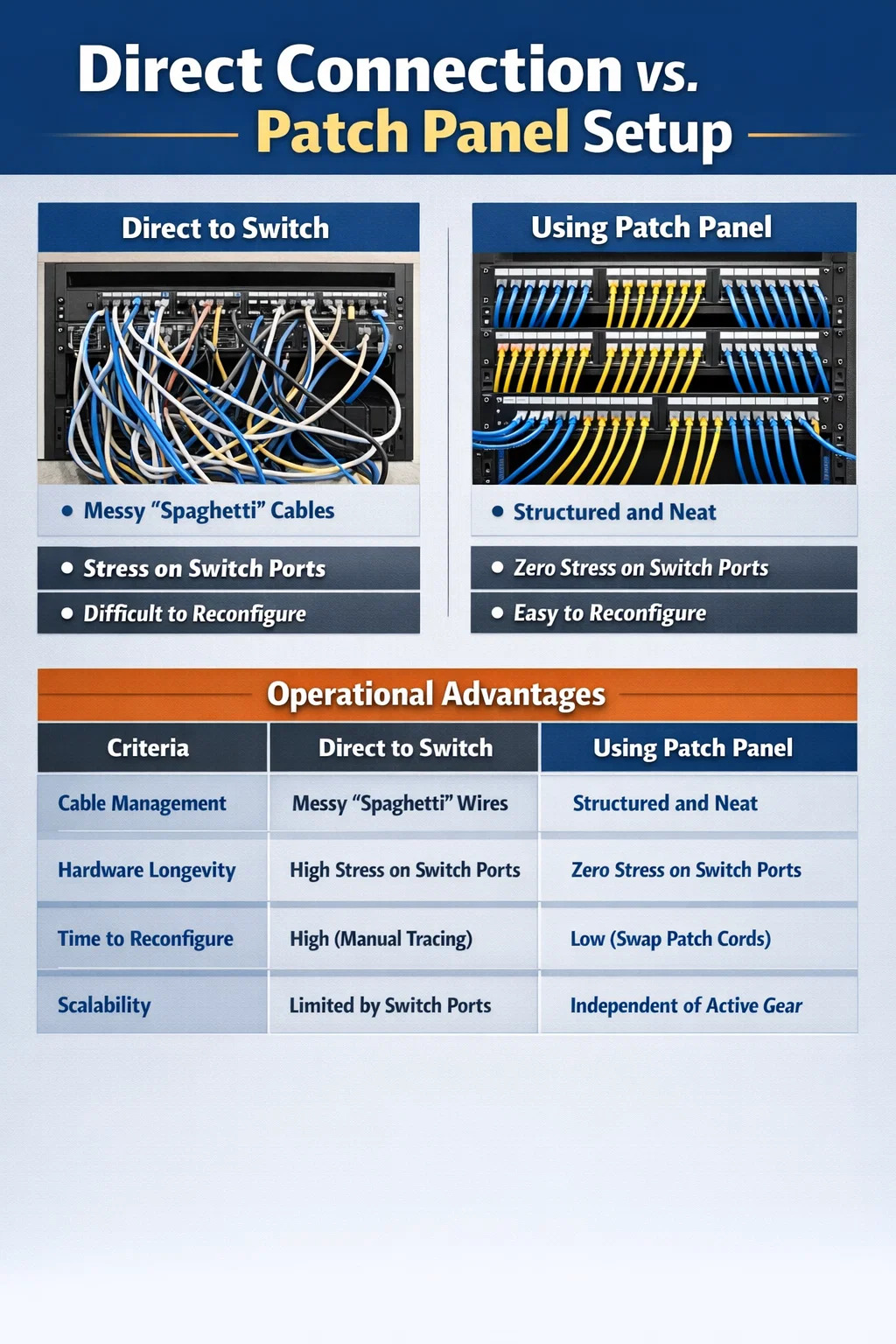
Comparison of Direct Connection vs. Patch Panel Setup
For those deciding whether the extra hardware is worth the cost, consider the following operational differences:
| Criteria | Direct to Switch | Using Patch Panel |
|---|---|---|
| Cable Management | Messy "Spaghetti" wires | Structured and neat |
| Hardware Longevity | High stress on switch ports | Zero stress on switch ports |
| Time to Reconfigure | High (tracing wires manually) | Low (move a 1-foot patch cord) |
| Scalability | Limited by switch port count | Independent of active gear |
Future-Proofing and Upgradability
Network technology evolves rapidly. Today you might be using a 1Gbps switch, but in three years, you may want to upgrade to a 10Gbps PoE++ switch for high-end Wi-Fi 7 access points. If your cables are directly connected to the old switch, the upgrade involves unplugging everything and risking cable damage.
With a network patch panel, your permanent infrastructure stays untouched. You simply swap out the switch and plug in new patch cords. Furthermore, a modular panel using keystone jacks allows you to upgrade individual ports. For example, you could replace a copper jack with a fiber optic jack for a specific workstation without replacing the entire panel.
Ultimately, the "bother" of installing a patch panel pays for itself the very first time you need to move a piece of equipment, identify a broken line, or upgrade your network speed. It is the hallmark of a professional installation that prioritizes reliability over shortcuts.
Are you ready to
cooperate with PUXIN?
cooperate with PUXIN?
Contact us to find out how our products can transform your business and
take it to the next level.

Ningbo Puxin Electronic Technology Co., Ltd. is a professional supplier of electrical engineering and integrated wiring product research and development and manufacturing.
Quick Links
Products
Keep In Touch
-

No.43 of Xiaotuanpu Road, Guanhaiwei Town, Cixi Ningbo City, Zhejiang, China
-

-

8615924366333
-

Mobile web